
The 30 members of the Civic Assembly are selected!
On January 28th, in a live public and broadcasted event, we randomly and anonymously selected the 36 members of Lexington’s first Civic Assembly. The process we used is called a civic lottery, which allowed for the members to be selected randomly and representatively. Learn more about this process below.
The members of Lexington’s first Civic Assembly*
Adam K
Alexander S
Camae M
Catherine Z
Christina E
Connor J
David C
David H
Edward M
Hailey S
Jake M
James G
Jennifer W
Joshua A
Kirsten S
Larry S
Michelle W
Laura F
Madison L
Orion S
Pam B
Robert S
Samuel T
Shelly K
Stephen P
Terri C
Thomas C
Vicki C
Zofia Z
Zuri E
*Due to some withdraws and time constraints, the final assembly group was 30 people. The list above is the final list of assembly members, which includes some alternates from the originally drawn panel.
How does a civic lottery work?
We received over 340 applications for the Civic Assembly after sending out 11,500 postcards to randomly selected households across the county. The application asked for general demographic information like age, race, gender, educational background, and more. That data was made anonymous and put into a software called Panelot, which is designed to build representative and randomized panels (or groups of people, each represented by an ID number).
To be able to make panels that are representative, Panelot also needs demographic criteria. The criteria we looked at cover nine different demographics: age, race, gender, educational background, housing status, political registration, approximate income, council district, and affiliation to CivicLex. Representation is important to us, so we want to highlight that accounting for nine demographics is much higher than other assemblies! Typically, assemblies only account for one or two demographics — European assemblies usually only consider age and gender.
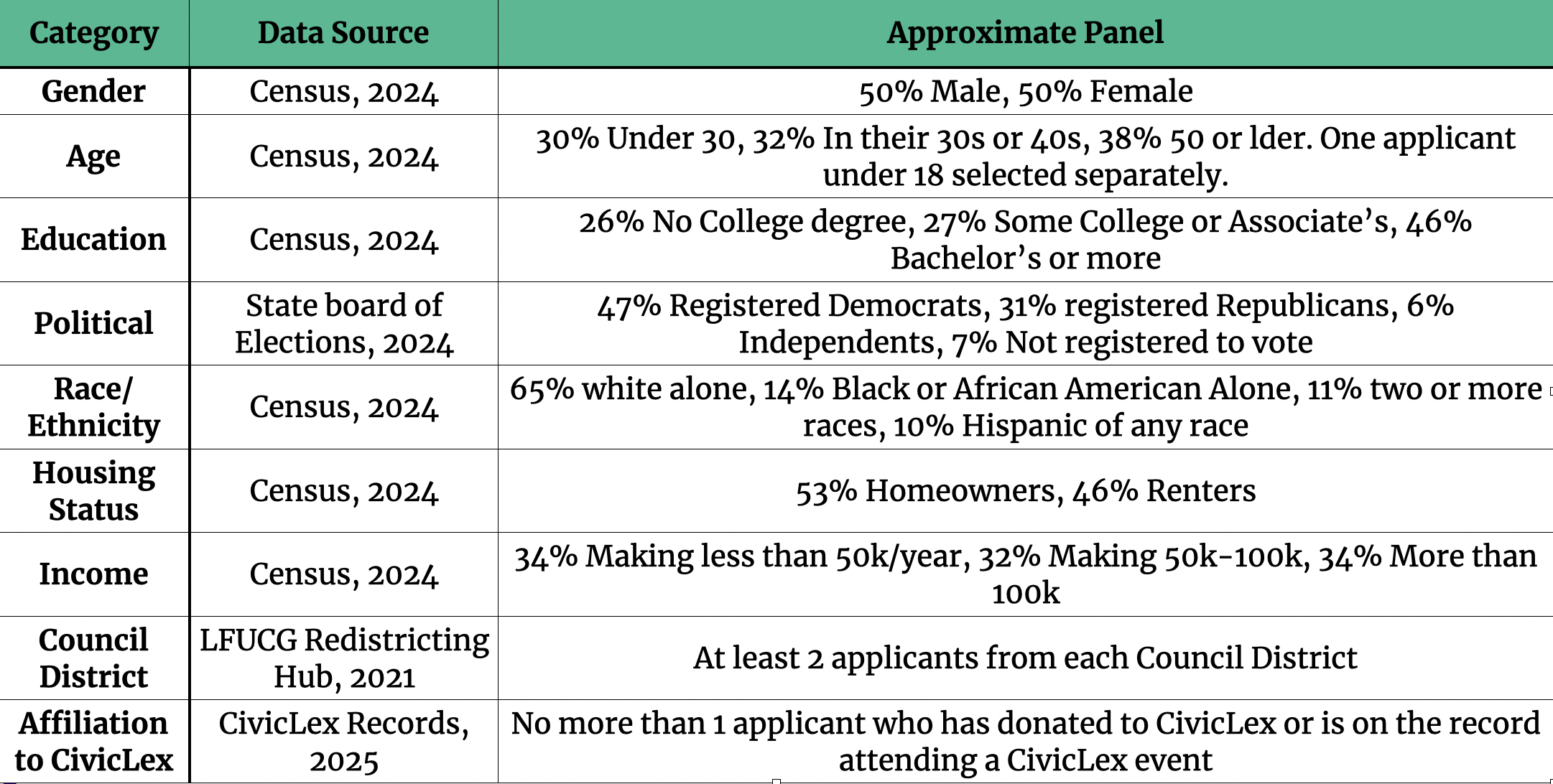
We used Census, public source, and our own data to find what these demographics look like in Lexington, and therefore what we want the Civic Assembly to look like overall. The image to the right shows a summary of the demographic criteria we used.
For example, according 2024 Census data, Lexington is 50% male and 50% female — so we want our assembly to be made up of roughly 50% men and 50% women.*
But Panelot doesn’t actually choose which panel will be on the Civic Assembly. We did that with a bingo cage!
With the anonymous application data and demographic criteria we put into Panelot, it was able to create 204 possible panels for the assembly. So we put 204 balls into a bingo cage, and randomly drew the panel for the Civic Assembly, which was panel number 24! We livestreamed this selection process, you can watch the recording here.
During the civic lottery, we read the panel number, the ID number for each person, and then their first name and last initial. You might notice that only 35 of the 36 assembly members were chosen with Panelot. That is because the 36th member is a youth representative between the ages of 16 and 18, who was drawn separately off camera to make sure their privacy is fully protected.
If any selected assembly members have to withdraw, we will work with faculty at the University of Kentucky Martin School to select a new member that most closely matches the demographics of the original member. All of the applicants who were not selected for the Assembly will be entered into this alternate pool, unless they choose to withdraw.
*We want to note that the Assembly representation is by no means perfect. It’s an important part of the lottery process to set target ranges (with a minimum and a maximum) for the demographic criteria. We know we can’t get 36 people to perfectly match the demographics listed in the table above, but the overall assembly demographics fall within the acceptable ranges set.
We want to be as transparent as possible with this process, so we’ve added some detailed resources below — including a more in depth explainer of how the civic lottery works. You can also see the set demographic ranges and the numbered list of generated panels with ID numbers.
Please don’t hesitate to reach out to Kit Anderson at kit@civiclex.org with any questions!