
About Lexington’s first Civic Assembly
This page provides more information on the process of Civic Assemblies, what it will look like in Lexington, and why the Urban County Charter is important.
What is a Civic Assembly?
A Civic Assembly brings together a representative group of residents — selected at random — to learn about a big issue, hear from experts, talk with each other, and make recommendations for how things should change. Participants are compensated for their time and are facilitated in their meetings. It’s a great way to bring everyday people deep into the decisions that shape our community.
Over the past 30 years, Civic Assemblies have been used more than 700 times around the world to tackle complex and challenging issues. They’re usually organized by governments or outside organizations that want better, more democratic ways to solve problems.
How do Civic Assemblies Work?
-
Civic Assemblies are built to propose solutions to a complicated issue.
Typically, a government or outside organization will “commission” the assembly, by selecting a topic, funding the assembly, and kickstarting the process.
-
Civic Assemblies are built using a lottery system. Random addresses are selected across the county, and letters are sent out informing recipients that they have been selected to participate. Recipients fill out a demographic survey, and send it back confirming their interest in participating.
Typically, thousands of letters are sent out to build a 15-30 person Assembly. For Lexington’s Assembly, 10,000 randomly selected addresses were provided by LFUCG and Fayette County PVA.
-
From the surveys, the entity putting on the Assembly will build several random and anonymous panels of respondents using only demographic information — these panels are the options for who would participate in an Assembly.
The panels are designed to be fully representative across political affiliation, race, age, and other factors.
One of the panels is randomly selected to be the Assembly.
-
The Assembly is convened in a publicly-accessible location over several full days.
First, they start by learning about the issue they are there to address. They are presented with educational materials and hear testimony from witnesses — formal experts, people with opposing perspectives, and people who will be clearly affected by the decision.
-
After the Assembly has heard from witnesses, they discuss what they’ve heard and what they think the best solutions would be to address the issue they’re discussing.
Throughout this process, healthy disagreement is strongly encouraged, and Assembly members are guided by facilitation to eventually produce an opinion (or set of opinions) that most or all can agree on that recommends solutions to the issue.
-
At the end of the process, the Assembly presents its opinions and recommendations to the commissioning body, a legislative body, or policymakers and requests a response.
Sometimes recommendations from Civic Assemblies are implemented via ballot measure, lawmaking, or policymaking — but this is not up to the Assembly to implement.
What will Lexington’s Civic Assembly look like?
In the Spring of 2026, CivicLex will host Lexington’s first-ever Civic Assembly. The topic? How our government works.
Lexington’s first Civic Assembly will be focused on the question “What changes should be made to Lexington’s Charter to improve representation, trust, and participation in local government?”. The Assembly will come together across 7-8 weeks in March of 2026 to recommend potential changes to the Urban County Charter, which is essentially Lexington’s local constitution. They will specifically be looking at Council compensation and Charter review, read more on the topics here.
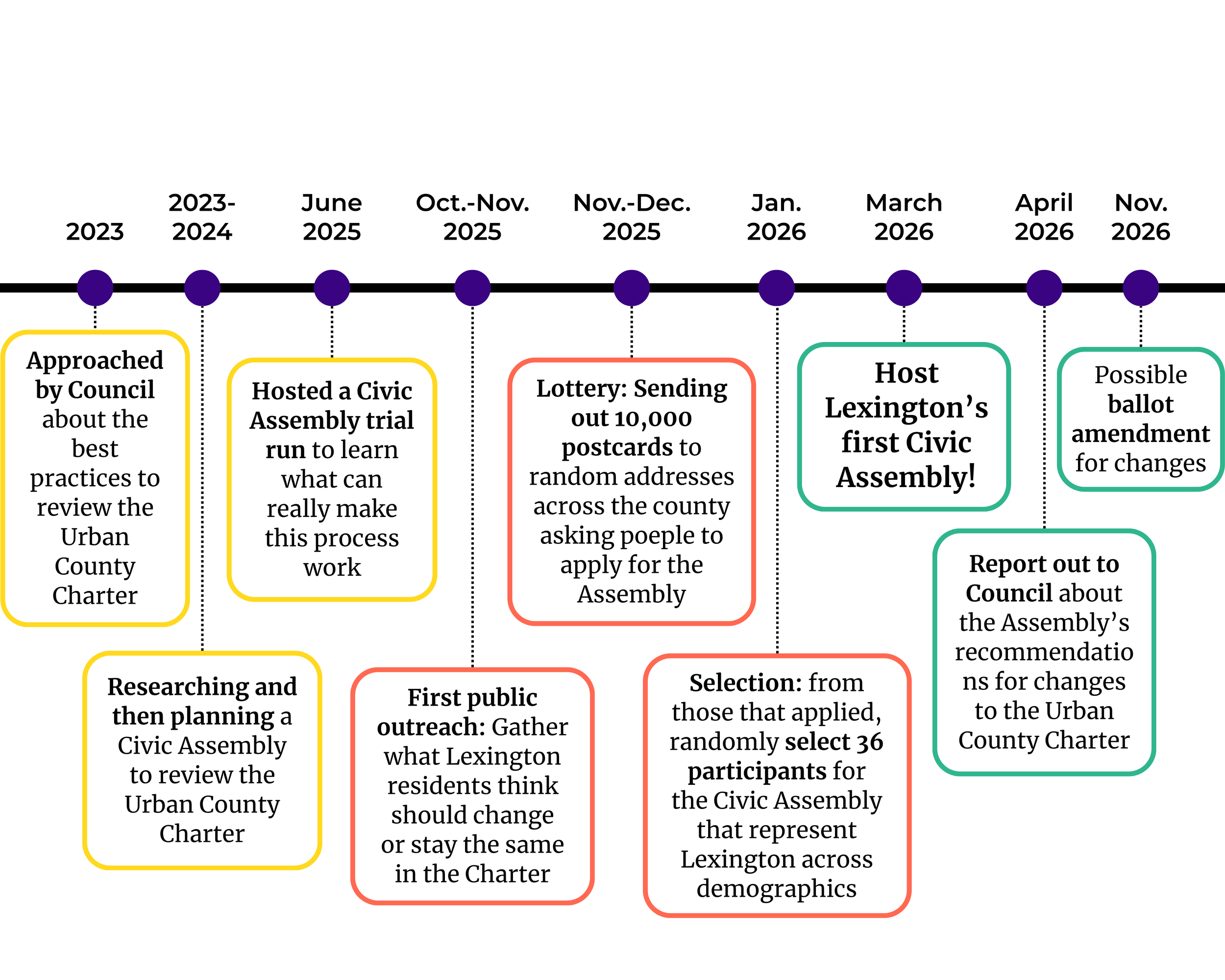
Overview of the Civic Assembly timeline
There will be 36 people in Lexington’s Civic Assembly, selected by lottery through a mailing of 11,500 letters that were sent out in November of 2025 to random addresses across Lexington asking residents to apply. The Assembly members were selected at random from this group of applicants to match the city’s demographics across age, political affiliation, race, and more. Learn more about the selection process here.
Assembly members are compensated for their time, provided childcare and transportation stipends if they need it, and given any other necessary accessibility accommodations.
Recommendations about changes to the Urban County Charter from the Assembly will be presented to Urban County Council, which has decision-making power over what happens to them. Council has committed to publicly and formally responding to recommendations as they are presented.
What is the Urban County Charter?
The Urban County Charter is like Lexington’s local constitution.
It’s the rulebook that outlines how our local government is set up, what it’s allowed to do, and the rules it has to follow. The concept of a city charter has been around for a long time, but they became much more formalized with the release of the National Civic League’s Model City Charter in the year 1900.
Lexington’s city charter dates back to 1972, when the city of Lexington and Fayette County merged. Since its adoption, there have been several attempts to amend the charter — some successful, some not — but it has not been formally reviewed or updated since 1998.
Previous reviews of the Charter
1998
Lexington’s Chamber of Commerce undertakes a public review of the charter — not a city-led process.
The Chamber assembles a Committee to review the charter, which makes seven recommendations, many of which were controversial at the time:
Eliminating the Citizen Advocate position
Lengthening District Council Terms to 4 years
The Council at the time only put one item on the ballot — lengthening Council terms. It was ultimately defeated on the ballot.
1987
LFUCG’s Urban County Council undertakes a review via Charter Commission — a city-led proicess.
The Commission makes several recommendations, many of which were very controversial at the time:
Extending Mayoral term limits to 12 years from 8 years
Changing how the Vice Mayor is elected — from a Council vote to a public vote
Both of these were ultimately adopted by the public via ballot referendum.
What were challenges with past Charter processes?
In early planning for this project, CivicLex reviewed dozens of news clippings and reports from previous Charter review processes. We found several recurring challenges, including:
Council’s proximity to charter review:
“The council badly needs distance from the issue. It's impossible for us to be objective." – Councilmember Pam Miller, 1987, Lexington Herald-Leader
Limited public engagement:
“We are completely destroying the charter when we don't have more public input.” – Councilmember Debra Hensley, 1987, Lexington Herald-Leader
We believe that a Civic Assembly is perfectly suited to address these concerns!
Resources
Recent Civic Assemblies
Deschutes County, Oregon
PBS OPB: Deschutes County citizens come together for civic assembly
New Yorker: What Could Citizens’ Assemblies Do for American Politics?
Montrose, Colorado
More on Civic Assemblies
About Assemblies:
About Sortition: